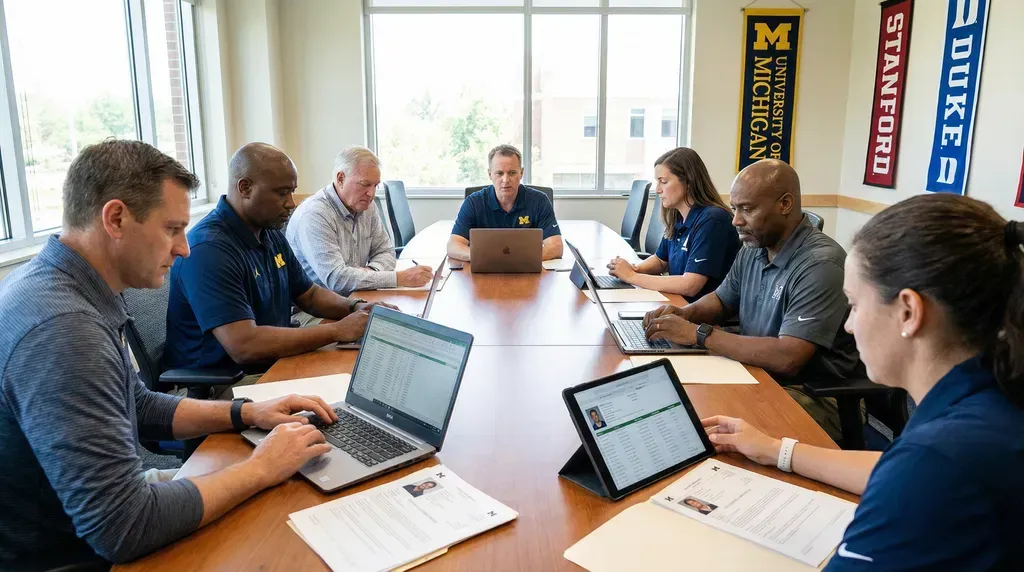
How Do College Coaches Actually Find & Discover New Athletes
One of the biggest misconceptions in recruiting is that college coaches are magically discovering athletes everywhere they go.
That's not really how it works.
Most families imagine coaches traveling around the country, sitting in the bleachers, stumbling across hidden gems, and handing out offers on the spot.
In reality, recruiting is much more systematic than that.
College coaches are usually looking for very specific athletes in very specific situations.
And understanding how coaches actually find players can completely change how families approach recruiting.
Coaches Start With Need
Before a coach sends an email, attends a showcase, opens Hudl, or watches a single highlight video, they usually start with one thing:
Their roster.
The first question coaches ask is:
"What do we need?"
Because coaches are not recruiting every position and every graduation class every single year.
They may need:
A 2028 catcher
A 2027 midfielder
A right-handed pitcher
A left tackle
A goalkeeper
Recruiting is not simply about finding the best athletes available.
It's about finding the best athletes who fit the specific needs of the program.
This is important because many families assume:
"If my athlete is talented enough, coaches will find them."
But recruiting doesn't work in a vacuum.
A coach may think your athlete is good.
But if they already have four athletes at that position in that grad class, they may not recruit them.
Fit matters.
Timing matters.
Roster construction matters.
The First Place Coaches Usually Look
Once coaches identify what they need, many of them go to their trusted network first.
Typically, they'll contact coaches they already trust.
That may include:
Club coaches
High school coaches
Travel ball coaches
Trainers
Recruiting contacts
Usually, these are people who have previously helped them find successful players.
So the coach may say:
"Do you have any 2028 shortstops?"
Or:
"Do you know any available outside hitters in the 2029 class?"
Now here's the important part:
Many families dramatically overestimate how effective this process actually is.
Yes, connections can help.
But this is a very narrow strategy.
Think about the odds.
The coach needs:
The exact position
The exact graduation class
The right talent level
The right academic fit
The right personality fit
And the trusted connection needs to happen to know someone who checks all those boxes.
Sometimes that works.
A lot of times it doesn't.
Some college coaches only have a handful of trusted people they call.
Some have almost none.
Which means they still need to find athletes elsewhere.
That's why relying entirely on "connections" is risky for most families.
Connections can help spearhead recruiting.
But they rarely replace a full recruiting strategy.
Not sure where your family stands right now? Take our free 2-minute 100K Scholarship Roadmap quiz to find out which stage of recruiting you're in and get a free recruiting guide customized to your situation.
Coaches Check Their Emails and DMs
If coaches don't immediately find what they need through trusted relationships, they'll usually move to the next place:
Their inbox.
And yes — coaches absolutely do check recruiting emails and DMs.
This surprises many families because they've been told things like:
"Coaches don't read emails."
"Social media doesn't matter."
"You need connections to get recruited."
That's simply not true.
Remember:
Coaches still need players.
And if they haven't found them yet, they're going to continue searching.
When coaches open recruiting emails or DMs, they're usually evaluating a few things quickly:
Does this athlete fit a need?
Is the graduation year relevant?
Is the position relevant?
Does the video look promising?
Are the stats interesting?
Is this worth further evaluation?
If the answer is yes, the athlete may go onto a watch list.
If not, the coach moves on.
That's why recruiting communication matters so much.
Most athletes are not losing opportunities because coaches hate outreach.
They're losing opportunities because their outreach is ineffective.
Different Sports Prioritize Different Platforms
Another thing families often misunderstand:
Not every sport recruits the same way.
Some sports rely heavily on email.
Others rely heavily on social media.
For example:
Soccer recruiting tends to rely heavily on email.
Football recruiting tends to rely heavily on social media.
And even within social media, some sports prioritize different platforms.
Some coaches spend more time on:
Twitter/X
Instagram
TikTok
Hudl
It varies significantly by sport and coaching staff.
That's why copying another athlete's recruiting strategy without understanding your sport can be dangerous.
A strategy that works extremely well in football may not work nearly as well in soccer or baseball.
Coaches Also Search Social Media
This is one of the fastest-growing parts of recruiting.
Coaches actively search social media looking for athletes who fit the positions and graduation classes they need.
They may search:
Hashtags
Position keywords
Graduation years
Highlight clips
Recruiting accounts
Shared posts
This is one reason why consistent content matters so much.
Every post is another opportunity to appear in front of a coach who happens to need your position and grad class.
Families often underestimate how much visibility compounds over time.
One post probably won't change everything.
But hundreds of posts over multiple years?
That creates surface area.
And surface area creates opportunity.
Want help building your athlete's visibility? Inside Scholarship University, families get access to coach outreach scripts, AI recruiting tools, school research tools, and systems designed to help athletes create more recruiting opportunities.
What About Rankings and Recruiting Websites?
Yes, coaches do sometimes check rankings and recruiting write-ups.
But usually not in the way families imagine.
Rankings are rarely the primary way coaches find athletes.
Instead, rankings are often used as a secondary search tool.
For example, if a coach still hasn't found what they need through:
Trusted connections
Email
DMs
Social media
Existing watch lists
Then they may look through rankings or recruiting databases to see if there are any uncommitted athletes worth evaluating.
But this is not usually a massive source of recruiting discovery.
Which is important because many families become overly focused on rankings.
In reality, plenty of athletes get recruited without being highly ranked.
How Coaches Actually Use Camps and Showcases
This is where many families get recruiting completely backward.
Parents often assume camps and showcases are the primary way coaches discover athletes.
Sometimes that happens.
But much less often than people think.
Remember:
College coaches have limited time and limited budgets.
Attending events costs money.
Travel takes time.
Coaches can only attend so many events.
So they tend to be strategic.
Most coaches are not randomly showing up hoping to discover completely unknown athletes.
Instead, they usually use the methods we've already discussed to build a watch list first.
Then they attend events where those athletes will be playing.
In other words:
The event is often the confirmation step.
Not the discovery step.
That's a huge distinction.
Could a coach discover a brand-new athlete at an event?
Absolutely.
It happens.
But it's usually a much smaller percentage than families realize.
Most of the time, coaches attend events to evaluate players they already know about.
Players they've already emailed with.
Players they've already watched on video.
Players already on their recruiting board.
That's why exposure before the event matters so much.
The Biggest Recruiting Mistake Families Make
Many families wait passively for coaches to find their athlete.
But once you understand how recruiting actually works, you realize something important:
College coaches are not conducting unlimited searches across the entire country for every athlete.
They're trying to efficiently solve roster needs.
And because coaches are busy, athletes who make themselves easy to find, easy to evaluate, and easy to communicate with often have a major advantage.
That's why successful recruiting usually comes down to three things:
Visibility
Positioning
Consistency
The athletes who consistently put themselves in front of coaches create far more opportunities than athletes who simply hope to get discovered.
Quick resource: Download our free 2026 Recruiting Trends Report to learn how coaches are changing the way they recruit athletes and what families should be doing differently today.
So, How Do Coaches Find Athletes?
Here's the simplified version:
Coaches identify roster needs.
They ask trusted connections.
They check emails and DMs.
They search social media.
They review rankings and recruiting sites.
They attend events to evaluate athletes already on their radar.
Understanding this changes recruiting completely.
Because once you understand how coaches actually search for players, you stop relying on luck.
And you start focusing on becoming easier to find.
Want Expert Help Navigating the Recruiting Process?
If you'd like one-on-one guidance and a complete recruiting strategy for your family, apply to work with our team.
We'll help your athlete create exposure, communicate with coaches, build targeted school lists, and maximize recruiting opportunities.