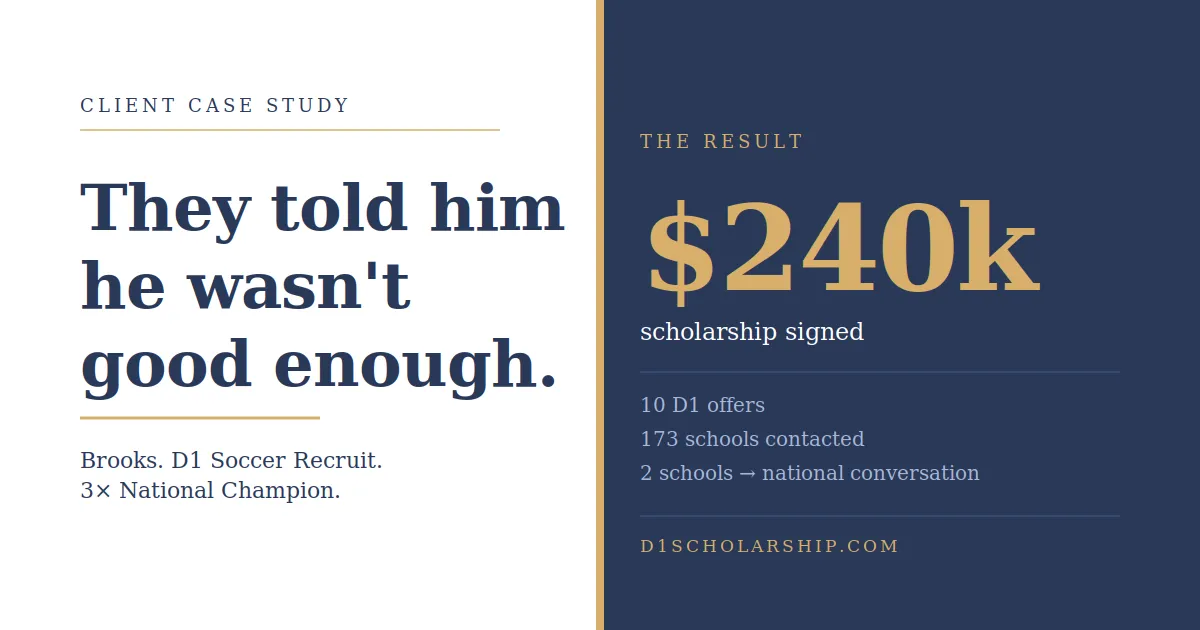
They Told Him He Wasn't Good Enough for D1. He Signed a $240,000 Scholarship.
Nate had just gotten off the phone with a recruiting service.
They hadn't asked to see any video of his son Brooks. They hadn't asked about his stats, his position, his work ethic, or the fact that his team had won three national championships. They had asked one thing: what league does he play in?
When Nate told them — US Youth Soccer National League, not MLS Next, not ECNL — the conversation was essentially over. "Your son's not good enough to play D1," they told him. Flat. Certain. Final.
Nate hung up.
"Yeah, we're good," he thought.
Eighteen months later, Brooks signed a $240,000 scholarship to play D1 soccer at a highly selective academic university on the East Coast — the kind of school people call "Ivy League caliber." He had 10 D1 offers to choose from, from programs spread across the country. Several were full rides.
This is the story of how they got there.
The Dad Who Built His Own Database
Before any of this, Nate tried to figure it out himself.
He's a smart guy. Resourceful. When he didn't know something, he researched it. So when it became clear that Brooks had a real shot at playing college soccer, Nate did what any driven parent would do: he got to work.
He built a spreadsheet from scratch. Every D1 men's soccer program in the country. Every D2 program. Coaches' names. Email addresses. Phone numbers where he could find them. Conference affiliations. He spent hours — plural — editing a highlight video, adding a halo effect that followed Brooks around the screen, a title page with stats, everything he thought a coach would want to see.
And then he started emailing.
The responses he got back, over and over, were some version of: Come to our camp.
That was it. Come to our camp. Come to our camp. Come to our camp. Because that's legally all coaches could say before the June 15th communication window opened. Nate knew they were spinning their wheels. He could feel it.
"We didn't know what we didn't know," he said later. "We had to start emailing people — but like, what is this email even supposed to be?"
So they paused. Not because they gave up, but because Nate is the kind of person who doesn't want to waste effort. When they got serious about this, he wanted to know what actually worked.
🎙️ Watch the Full Interview With Nate Here
Everything you just read came from a single conversation with Nate — unscripted, unfiltered, and incredibly honest about what the recruiting process actually looks like from a parent's perspective.
If you want to hear it in his own words — the frustration, the turning point, the moment Brooks said "Dad, this is who we've got to use" — the full interview is worth every minute.
The Service That Never Watched a Single Video
Before coming to D1 Scholarship, Nate went down the road with another group. They came recommended. They seemed credible. Nate was pretty far along in the process with them.
But something didn't feel right.
They were pushy. Transactional. And when they assessed Brooks's recruiting potential, they based it entirely on league affiliation. Brooks played in US Youth Soccer National League — what a lot of people in club soccer consider the lowest rung of competitive youth leagues.
They never asked to watch film. Never asked about his on-field performance, his leadership, his character, his grades. Just the league.
"There's no way he's playing at the D1 level," they told Nate.
Here's what they didn't know: Brooks's team had never lost to an MLS Next or ECNL team they'd played. Three national championships. A core group of players who'd been together since childhood — a brotherhood, Nate called it — who'd put in the work and consistently beaten the "top tier" teams when given the chance.
They just didn't have the exposure. Nobody knew about them.
That's a very different problem than not being good enough.
Nate walked away from that service and called D1 Scholarship back.
Sound familiar? If someone has already told you your athlete isn't good enough — or if you've been grinding through this on your own and not getting traction — that's exactly the situation Nate was in when he came to us.
We'd love to learn about your athlete and show you what's actually possible.
"Dad, This Is Who We've Got to Use"
Nate had actually spoken with D1 Scholarship once before, early on, and pumped the brakes. He wasn't sure they were ready yet. He wanted to explore other options first — reasonable, honestly.
But after the other service embarrassed itself, he came back. And this time, he did something a little unorthodox: he brought Brooks onto the call.
Nate mostly listened. He watched as the conversation shifted away from sales talk and toward Brooks as a person — his strengths, his position, his style of play, what they could use as leverage to market him. It felt less like a business transaction and more like someone genuinely trying to understand his son.
When they hung up, Brooks turned to his dad.
"Hey Dad, this is who we've got to use."
They signed up shortly after.
Throwing the Biggest Net Possible
Brooks didn't know where he wanted to go to school. East Coast, probably. A good program. That was about as specific as it got. So the strategy was simple: throw the biggest net possible and see what came back.
They launched two campaigns — D1 schools first, then D2. Three-email sequences to start, hitting every program in the country. Not a seven-minute highlight reel with a cinematic halo effect. Short clips. Specific highlights. Quick, easy-to-read emails. Spoon-feeding coaches just enough to leave them wanting more.
What happened after that first campaign stopped Nate in his tracks.
Before: actively recruiting conversations with two local universities.
After: managing active conversations with over 100 schools.
He eventually blasted it out to D2 programs as well, and the number climbed higher. At the peak of the process, Nate was managing follow-ups to 173 schools simultaneously.
Every school that had responded at least once got the same message: here's some updated film, here's a couple of highlights, let me know if there's anything else I can share. Short. Simple. Consistent.
"You don't have to give them everything all at once," Nate said. "You want to leave them hungry for more."
7,500 Emails and a Marathon Mentality
The process ran from just before June 2024 through April or May of 2025. Nearly a year of active recruiting. Over 7,500 emails sent from Brooks's account (not manually — there's a more efficient way to do this, and Nate's the first to admit he did some of it the hard way because he enjoyed the customization).
Somewhere in there, almost by accident, they went to a showcase they weren't sure about — a random invite that Nate treated as a golf trip that happened to come with some soccer. Brooks went with his full team, which almost never happens at these things. Most ID camps have players going solo, trying to outshine each other instead of playing the way they actually play.
Brooks's team went out and beat every team from the top national leagues. Coaches who had no idea who these kids were suddenly had a lot of questions.
Off that one showcase, four players from Brooks's team eventually committed to college programs — including Brooks himself.
But here's the thing that Nate learned to appreciate about the process, especially during the quiet stretches when coaches went cold and it felt like nothing was happening:
They were always watching.
When Brooks finally started getting serious interest and offers, Nate asked every single coach the same question: aside from his ability and character, what kept you engaged? Why did you stay interested even during stretches when you weren't actively communicating back?
Every single coach gave him the same answer.
It was the consistency. The regular updates. The film that kept coming. The follow-through, even when Brooks had no way of knowing if anyone was paying attention. By the time they met him in person and watched him play, one coach told him: "It was like we already knew everything about him. He just had to prove what we already knew was true."
This is what a real recruiting campaign looks like — and you don't have to build it from scratch.
Nate figured out a lot of this as he went. The families we work with get the system, the sequences, the strategy, and a team in their corner from day one.
If you think your athlete has college potential and you're not sure where to start — or you've started and feel like you're spinning your wheels — let's talk.
The Result
10 D1 offers. Schools across the country — East Coast, West Coast, Midwest. Several full rides. Multiple conversations with programs Brooks genuinely wanted to attend.
In the end, he chose a highly selective academic institution on the East Coast and signed for $240,000 in scholarship money.
The kid a recruiting service had dismissed without watching a single video of him.
The kid whose team played in what people called the lowest league of competitive youth soccer.
The kid whose dad had spent evenings building databases and editing halo highlight videos before finally finding a process that worked.
Nate estimates he put in 200 to 300 hours over the course of the recruiting process. That's actually less than a full-time job for a year. And at $240,000, that math is pretty hard to argue with.
"That was a pretty valuable few hundred hours," Nate said.
What Nate Wants Every Parent to Know
Nate has become one of the most active voices in the D1 Scholarship parent community — sharing what he learned with families who are earlier in the process than he was. So when he offers advice, it comes from someone who has actually lived it, not someone selling an idea.
Here's what he'd tell parents who are in the middle of it right now:
Disconnect your emotions from the process — or at least try to. When a coach stops responding, it doesn't mean they've lost interest. They're often quietly watching everything you've sent them, building a file, biding their time. The stretch that feels like silence is often the stretch that matters most.
It's a marathon, not a sprint. This took nearly 18 months. Recruiting isn't a moment — it's a sustained campaign of consistent, professional communication over a long period of time. Parents who understand that going in are the ones who don't burn out or give up at the three-month mark.
You're not annoying coaches. You think you are. You're not. If you were, they'd tell you — they'd say "check back in a month" and you'd have your signal. Until then, short updates with quick-click highlights are quite literally part of their job. That's how they build their pipelines.
It's okay — necessary, actually — to help your kid. There's a stigma that says the athlete is supposed to drive the entire process themselves, and if they need their parents' help, it means they don't really want it. That's not just wrong — it's harmful. Brooks is his school's senior class president. He has training four days a week. He has games on weekends. He was applying to highly competitive academic programs at the same time. He's a valedictorian-level student and a full-time athlete. There were not enough hours in the day for him to manage 173 active school relationships on his own. Nate shouldered the work that Brooks couldn't, and Brooks is now going to a school that will change the trajectory of his life.
That's not a parent living through their kid. That's a family.
The coaches are not going to find your athlete. No matter how talented they are. Unless your child is in the top fraction of a percent nationally, coaches are not going to stumble across them on their own. There are too many athletes and not enough hours in the day. The ones who get recruited are the ones who consistently put themselves in front of coaches in the right ways, at the right times, with the right communication. That's not politics. That's just how it works.
"If you're not marketing your athlete," Nate said, "and you're not doing it consistently and in the right ways — they're not going to see you. They're not going to know you exist."
Every family Nate described — the ones spinning their wheels, the ones being told their kid isn't good enough, the ones trying to apply Instagram tips without a real system behind them — those are the families we built this program for.
If that's you, we'd love to talk. No pressure, no used-car salesmen tricks. Just an honest conversation about where your athlete is and what the path forward looks like.
Zero Downside
Looking back on the whole process — the database he built from scratch, the hours of emails, the Monday morning copy-paste routine, the moments of doubt, the showcase they almost skipped — Nate doesn't have a single regret.
"There's zero downside in my mind," he said. "It was all positive. And if I were to go back 18 months, I'd do it all over again."
Brooks is going to play D1 soccer at an incredible school. His dad helped him get there. And somewhere out there, a recruiting service that never bothered to watch a video of him has no idea.
Brooks's story isn't rare — it's repeatable. The difference is almost always the same thing: consistent, strategic exposure to the right coaches at the right time. If your athlete deserves to be seen, let's make sure they are.